By Richard Phillips
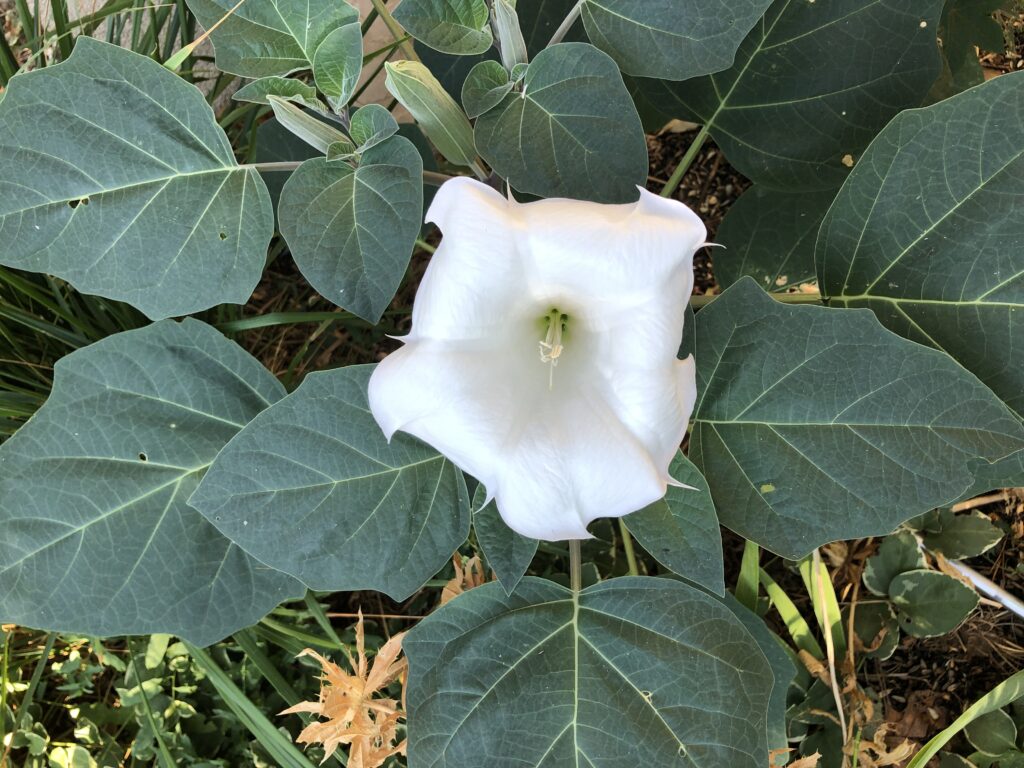
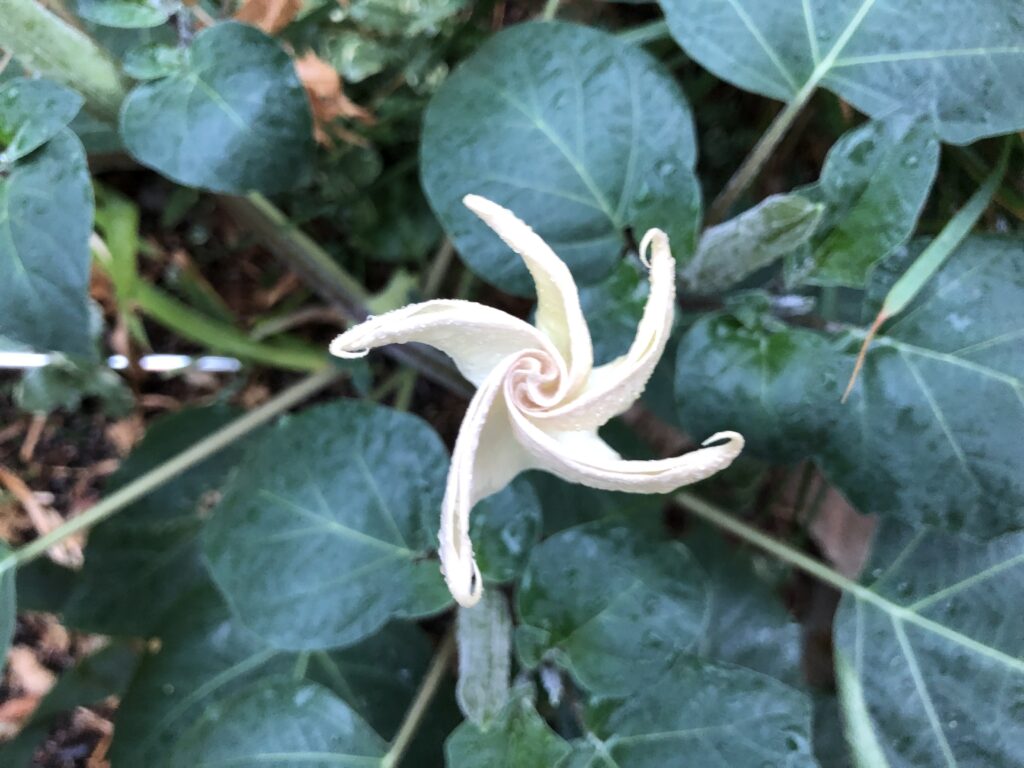
Datura in Full Bloom (All Photos by Vicki Saragoussi Phillips, unless noted otherwise)
One of my wife’s (Vicki) favorite plants is poisonous.
I was supposed to write an article about the Maximilian Sunflower (Helianthus maximiliani). In bed last night, I spent wakeful interludes making a mental list of what I needed to research and include in the article. Then, at breakfast, Vicki opened her phone and showed me her collection of Datura (Datura wrightii) pictures. I was so enchanted, that I decided that those pictures needed to be in the newsletter, so I changed my subject.
At our house, Datura is never far from sight. There is a prominent plant just outside the front door, that is visible from the breakfast table. There are two additional plants on the edges of the front patio. We monitor its growth every day, waiting for the flower pods to appear.
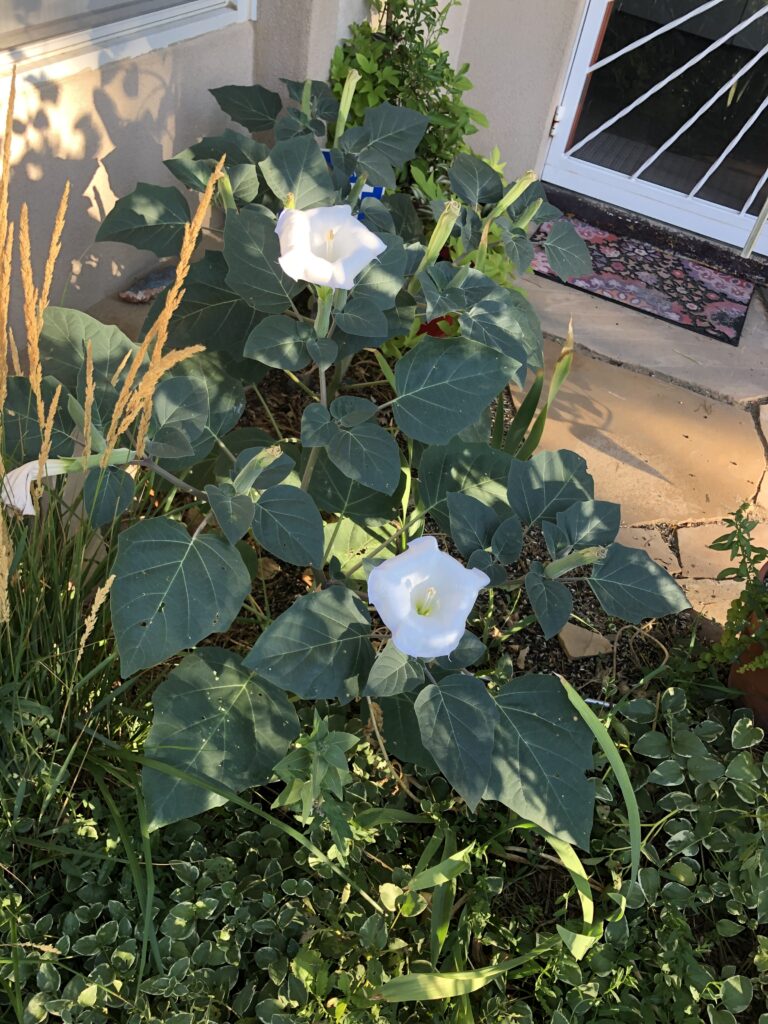
The plant just barely qualifies as being a Colorado native. According to Ackerfield in Flora of Colorado it is only native to Montezuma County in the southwestern corner of the state – think Mesa Verde. Elsewhere in Colorado, it would be considered a regional native.
It is not what you would expect for a plant adapted to an arid, desert environment. It has large showy leaves and a bushy growth pattern. With a little water it can grow over 3’ tall. Its most impressive feature is its white flower pod, known as a corolla.
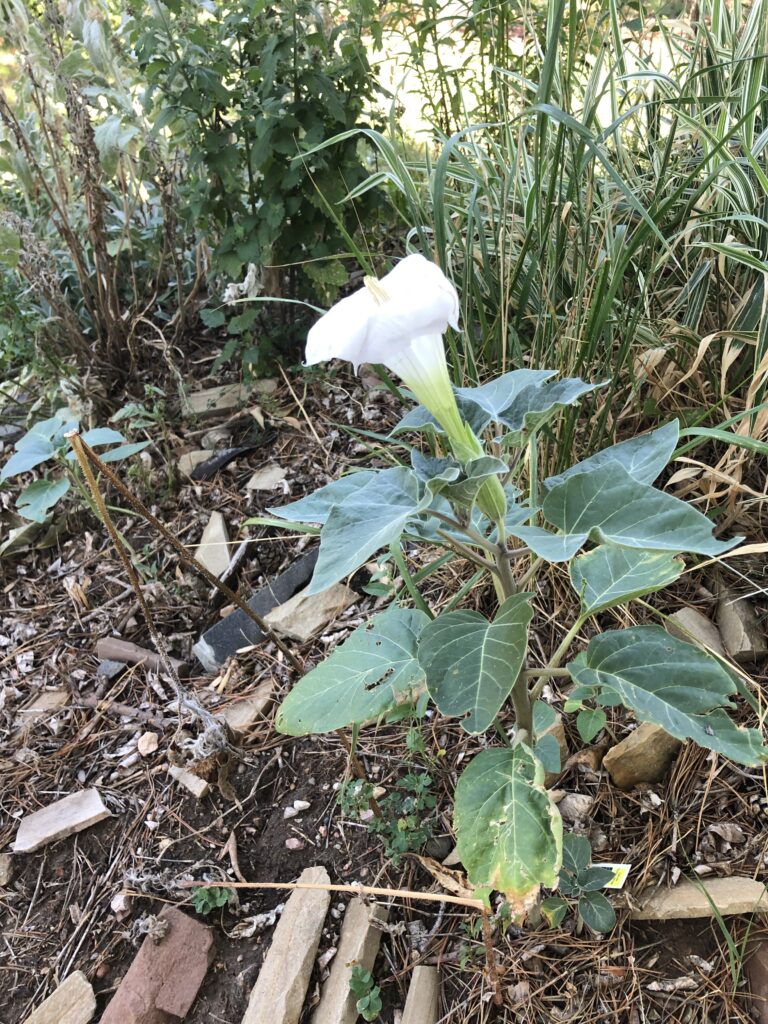
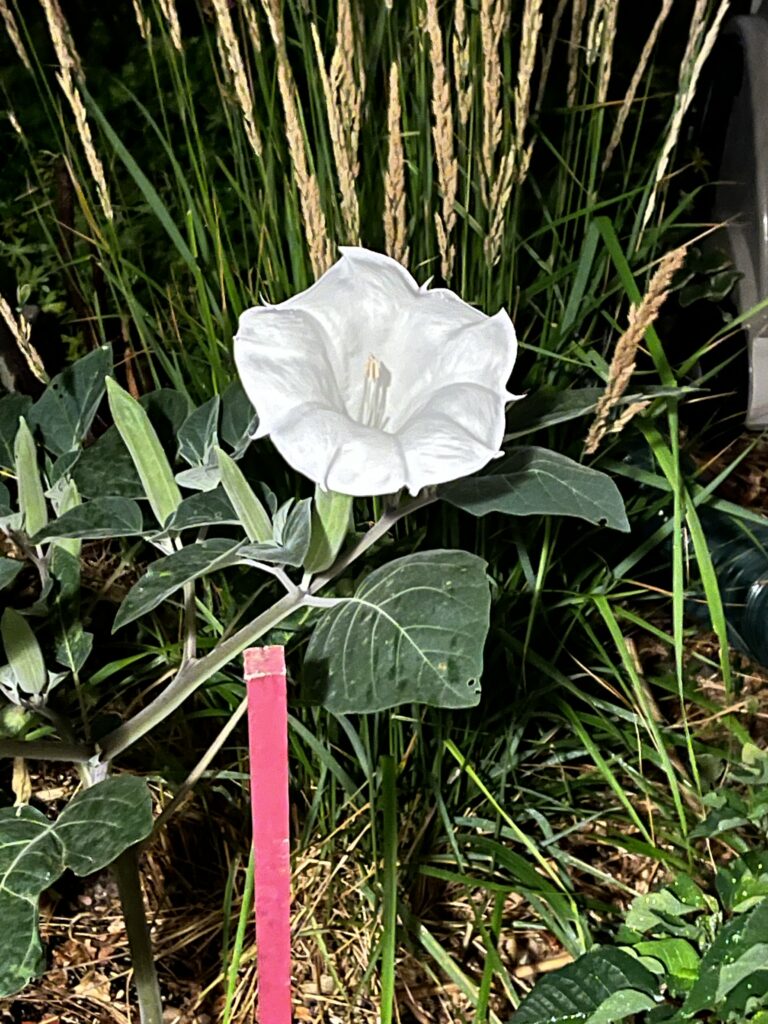
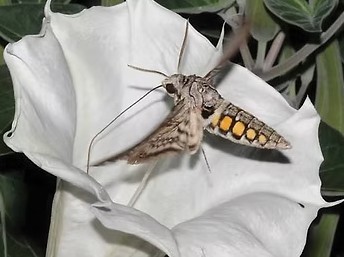
The showy corollas typically reach a length of 6”- 8”. Our plants typically produce a dozen or more blooms each, spread over a period of a week or two. The mature bloom can be tricky to catch. It doesn’t fully open until the evening and then is closed by morning. But this is plenty of time for its pollinator, the fascinating hawkmoth (also called a sphinx moth), to do its work. Vicki and I have been blessed several times to watch sphinx moths show up in the early evening. I can only wonder how evolution has produced this insect that can fly like a hummingbird and use its long proboscis to pollinate flowers like Datura.
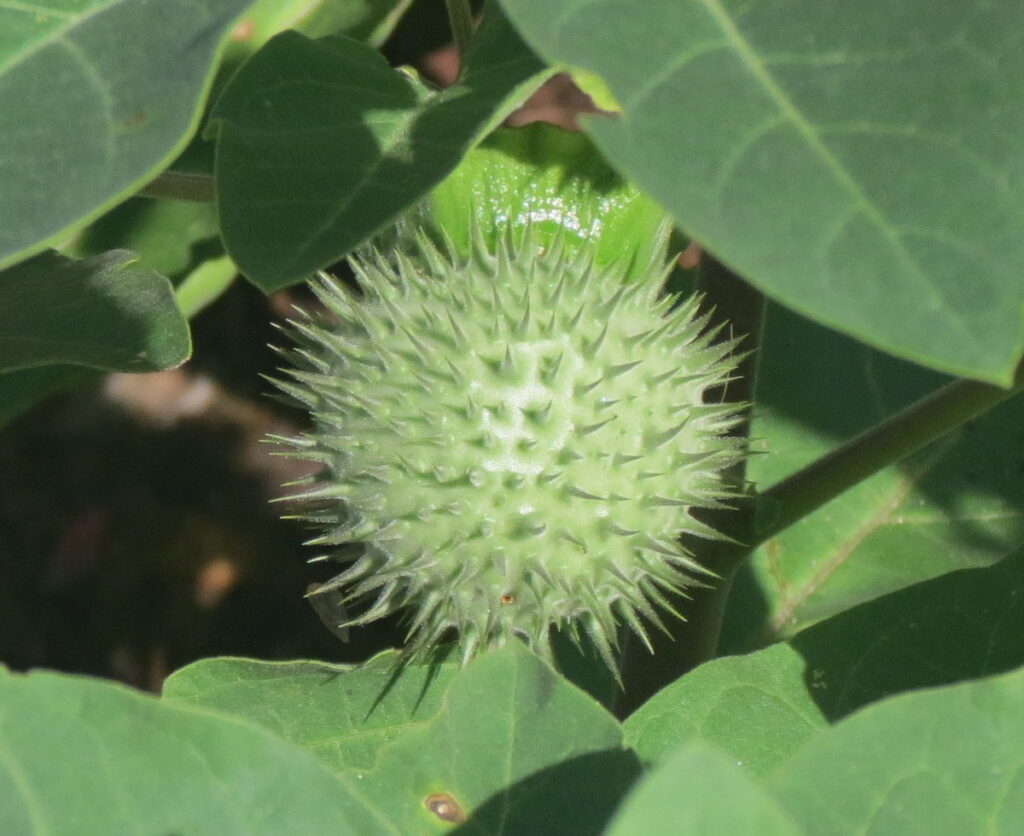
The plant’s uniqueness does not end with the blooms. After the blooms close and drop off, a large thorny seed pod is produced. It is about the size of a walnut. It evolves over several weeks, starting off green and fading to brown before it drops off the plant. Eventually the pod will open, revealing dozens of small seeds.
Datura is in the nightshade family, Solanaceae, all of which are poisonous to some extent. All parts of Datura are considered poisonous if ingested; this includes flowers, leaves, stems and seeds. It is also psychoactive. Southwestern indigenous people used the plant in sacred ceremonies because of its hallucinogenic qualities.
Vicki obsesses about the poisonous features of the plant. She is concerned that a child or pet will ingest part of it. However, we have never seen any dead pets or bunnies near the plant.
An extraordinary plant requires an extraordinary name. Datura has many common names, including devils’ trumpet, jimsonweed, thornapples, and more. My favorite is moonflower, no doubt due to its night-blooming habit.
The plant is fairly easy to start from seed. Cold stratification is not required to break dormancy. It is recommended to soak the seeds for 24 hours before planting them in a pot. Keep the soil moist and warm. Be patient, it may take 3 to 6 weeks before they germinate. You can also sow the seeds outdoors in the spring. It likes full sun. Datura is considered a short-lived perennial, but it readily reseeds itself.