
By Lani Rush
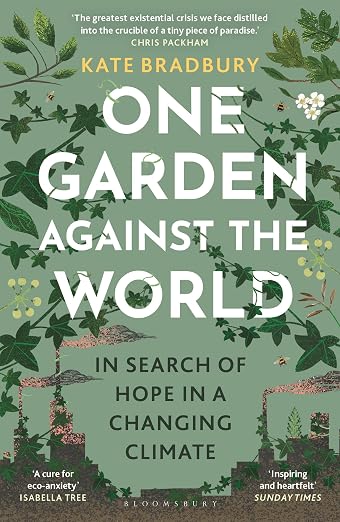
In author Kate Bradbury’s own words, she specializes in practical wildlife gardening and her latest book One Garden Against the World is a memoir told over the course of a year in her ‘modest’ and ‘relatable’ garden in the United Kingdom. In it, she focuses on the power of small fixes like growing plants for insects (bees, caterpillars) and providing resources for birds. The subtitle, In Search of Hope In a Changing Climate, lets the reader know that Kate is also aware of the need for meaningful climate action at a global scale. The book is her attempt to knit our macroscopic problems with solutions that are accessible and feasible – and that do make a difference to wildlife.
Bradbury’s love of the natural world (she calls it, along with her father and nephew “the gene”) is obvious and heartfelt. This book contains lovely descriptions of many of our urban garden creatures – birds and insects feature heavily, while containing animals we in our arid conditions might have less exposure to (e.g. frogs & toads). Hedgehogs are also very much a star – regularly viewed on night-time trail cameras by the author as she drinks her morning tea. Told in a month-as-a-chapter format, we are treated to observations related to the emergence, or lack thereof, to plants and animals. Given this is a seasonal memoir, the entirety of the book takes place from April 2022 to June 2023 and the story telling is at times a bit descriptive and simplistic. Bradbury’s retellings of what is happening in her garden often made me want to put the book aside to see what was happening in mine!
During the timespan of the book, there are several challenging weather patterns – particularly a drought in 2022 that strikes the garden despite Bradbury’s diligent efforts to collect and preciously allocate water. The author’s palpable despair at the current drought combines with her understanding of the impact of historic climate events (specifically a 1976 drought that caused marked insect decline in 1977) that makes for difficult reading. There are regularly uncomfortable rhetorical questions – ‘will the birds/plants be OK?’ – that can give the sense of overwhelming personal paralysis in the face of systemic issues.
The climate anxiety in this book might be challenging for some readers – I personally found Kate’s tenderness towards the difficulties of the creatures she both can see and influence (robins she supports in fledging) at times motivating and at times grating. There are allusions to structural changes, for instance climate actions, discussions with local environmental groups, and the knitting together of environmentally minded neighbors, but the book remains focused on practical, home-scale matters. I thought the most interesting parts of the book were often in the end notes of each chapter, which focuses on a specific creature and how to garden for them.
If you are fond of personal garden writing that is focused on detail, encounters with wildlife, and acknowledging the uncertainty of our times while trying to rise above inertia and melancholy, you will probably enjoy this book.