
Rhus glabra
By Karen Vanderwall and Kristine Johnson
Smooth sumac is a multi-stemmed woody plant or shrub native to the Front Range of Colorado as well as southwestern Colorado. A special feature of this shrub is that the leaves turn bright red in the fall, often forming wide brilliant swaths of scarlet across the landscape. These shrubs are dioecious, meaning each shrub has either male or female flowers. Male shrubs have pollen producing flowers but not the well-known red fruit clusters, found only on the female shrubs.
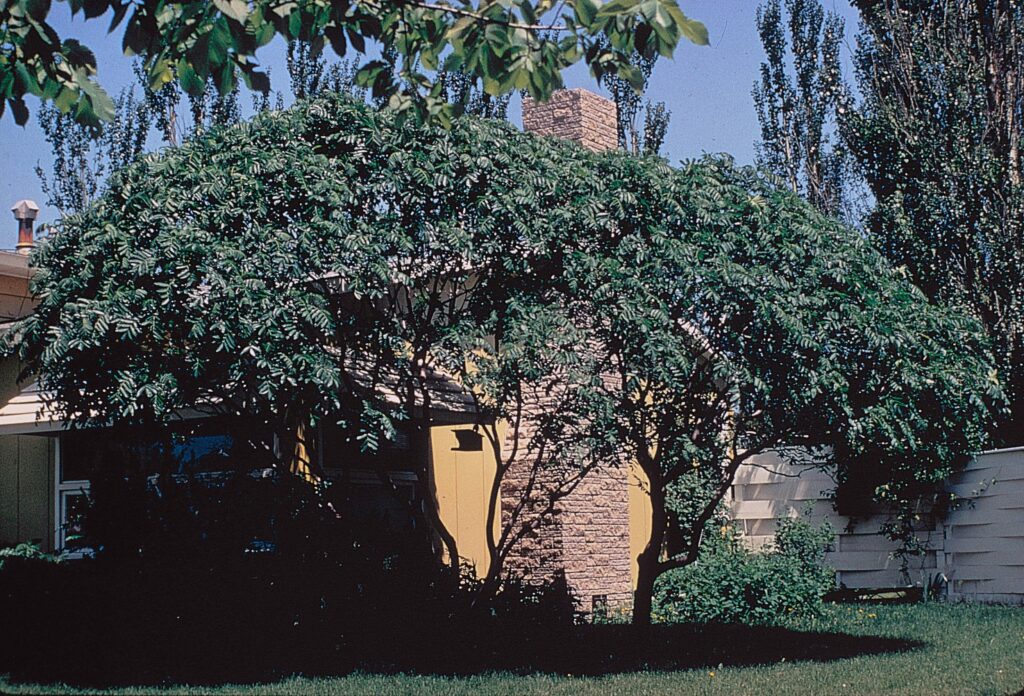
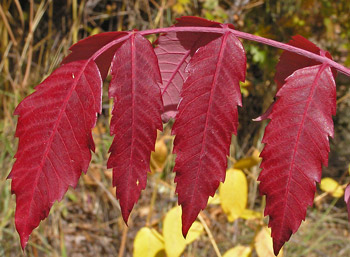
Smooth sumac is a versatile shrub that can grow in sunny, part shade and shady locations. It does very well in dry conditions and in most soil types. In natural landscapes, they are often found on hillsides—so you might consider them for the sloped areas of your own landscape.
Importance to Wildlife
Smooth sumac has high ecological value, attracting a wide variety of beneficial insects to its male flowers for pollen and to females flowers for their nectar. You’ll find mining bees, bumble bees, sweat bees and wasps all visiting for the nectar. Smooth sumac serves as a host plant for several butterfly and moth species, and their flowers and leaves support many beneficial predatory insects (which will control garden pests). Its leaves provide food for many pollinators whose caterpillars feed primarily on sumacs like the Spotted Datana Moth, a moth native to the Colorado Front Range.
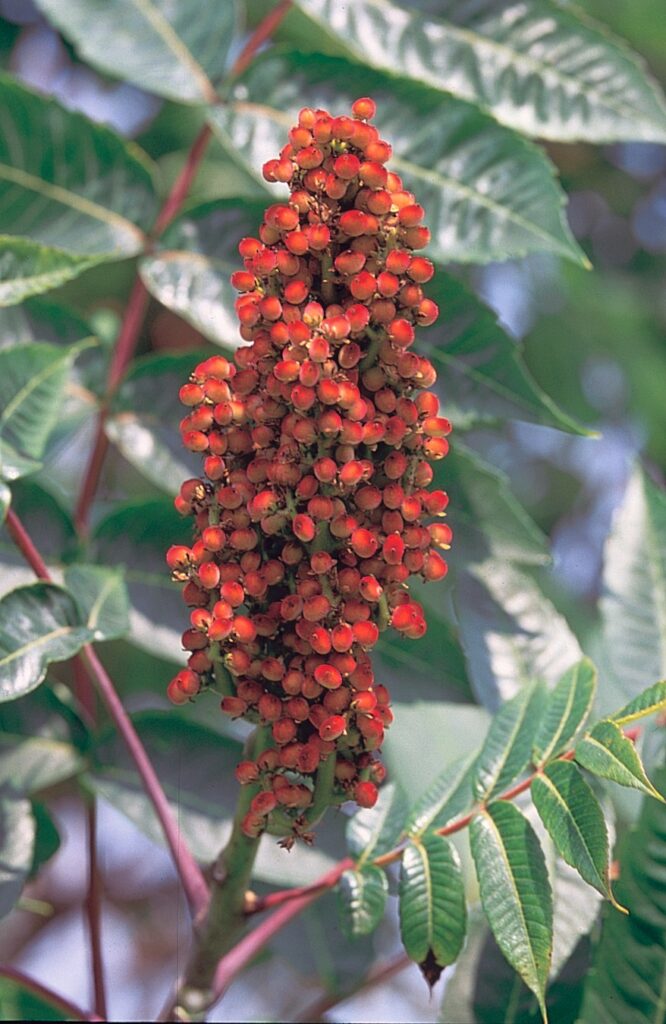
The fruit clusters are red, fuzzy drupes and provide food for roughly 300 species of birds. And the shrub’s wide growth habit provides excellent cover for birds and small mammals.
Beware…
Be aware that there is an invasive, non-native tree with no habitat value that is often confused with smooth sumac and other North American native sumacs. It’s called Tree of Heaven (Ailanthus altissima). While the foliage looks somewhat similar to that of smooth sumac, Tree of Heaven flowers and seed pods are quite different from that of smooth sumac. In addition, Tree of Heaven can get much much taller. One last identifying characteristic is that the leaves of Tree of Heaven have a distinctive “peanut butter” smell. If you suspect you have Tree of Heaven, you might consider contacting Denver Tree of Heaven to get advice on what to do next.
Resources:
Lady Bird Johnson Wildflower Center, Plant Database