Review by Karen Vanderwall
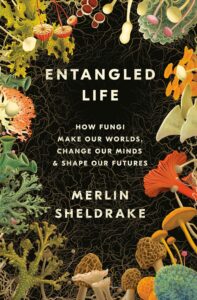
Entangled Life: How Fungi Make Our Worlds, Change Our Minds and Shape Our Futures by Merlin Sheldrake
Fungi are their own kingdom, the highest category in the classification system for all living things on Earth. There are only 6 kingdoms: animals, plants, fungi, and three that are mostly single-celled organisms. Taking a minute to fully process that fact, I realized how little I knew about fungi.
Entangled Life opens the door into the world of fungi and takes a deep dive. An intellectual Disney ride filled with ‘wow I didn’t know that’ moments happens throughout the whole book. When friends asked what I was reading, and I said a book about fungi, I got a look of ‘no thanks’; when I told them that there were many sections where I couldn’t put it down, they were surprised to say the least. Merlin Sheldrake is a PhD mycologist (one who studies fungi), a world traveler and adventurer, and a good writer. But for the most part, the fungi speak for themselves as fascinating, misunderstood, and under-studied living beings.
Sheldrake explains that fungi have existed for more than a billion years. They eat rocks, make soil, digest pollutants, nourish and kill plants, survive in space, induce psychedelic visions, produce food, make medicines, and manipulate animal behavior. They can be microscopic like yeasts or one of the largest organisms in the world – a honey fungus covers 3-4 square miles and is thought to be between 2400 – 8000 years old!
In the life of fungi, a single spore germinates to form a hypae. Hypae are microscopic and grow from their tips, breaking down organic matter and absorbing nutrients, supporting a network that connects to plants and trees: the mycorrhizal network. Mycorrhizal, a hefty word, is from the Greek: fungus- mykes/ root rhyza.
When plants were first evolving to live on land from the water, they collaborated with fungi to serve as their root system for many millions of years. Today 90 percent of plants still depend on fungi to give them the nutrients in the soil that they need. In turn, the fungi get sugars and lipids from the plants from the process of photosynthesis. The fungi and plant relationship is largely symbiotic. Not unlike local pollinators and birds, native plants co-evolved alongside native fungal networks in the Front Range as well. Native plant gardeners take note: these relationships are important because these networks deliver water and nutrients to the plant, enabling them to be drought tolerant and to adapt to low nutrient soil.
Another interesting and surprising fact – there are 2.2-3.8 million species of fungi and only 6 percent have been described! More – when we think of fungi we think of mushrooms, but the majority of fungal species do not even produce mushrooms.
The book is divided into fungal stories, like hunting truffles, whose olfactory compounds attract animals and can’t be domesticated because of their connection to plants. One chapter is dedicated to drugs or chemicals that are found in fungi. LSD and magic mushrooms are in this category. They can help ease the habits of the mind which helps conditions such as depression, addiction, and end of life. Why do fungi have these chemicals? Scientists think it is related to their use to manipulate animals like ants. This chapter is fascinating. Also included are captivating studies on fungal behavior: think chemical brains. Symbiotic fungal relationships with, for example, algae that partners with fungi to create lichens. Lichens’ superpower is dormancy and have been found in deserts and the Antarctic and can live to be 9000 years old. The entire book is full of unique knowledge and is written engagingly.
What else is there to say but – read this book! It will open your mind to a whole new world, or specifically, kingdom.
*Karen Vanderwall is on the Wild Ones Front Range Board. She gardens in Fort Collins, CO