
By Richard Phillips
Quercis gambellii, the Gambel Oak (also known as Gambel’s Oak) was described and named by the famous English/American naturalist Thomas Nuttall in 1848. He named the specimen after its collector, William Gambel, who found it in 1840 near Santa Fe, NM when he was only 19 years old, during a pioneering trip to the American Southwest. Gambel was a protégé of Nuttall, who trained the younger man in biology, geology and ornithology. Sadly, Gambel died at the young age of 27 years during a trip to California. He had gotten gold fever, left his new bride in the East, and died of typhoid in a miner’s camp. To further confuse you about how to spell the tree’s name, William’s family surname is actually Gamble, but at some point William began spelling it as Gambel.
Gambel Oak is known by several common names including Rocky Mountain White Oak, Utah White Oak and most commonly as the Scrub Oak. It is the most common oak found in Colorado. It typically grows in thickets, rarely exceeding 20 feet in height, but specimens as tall as 50 feet have been recorded. It has deeply lobed, deciduous leaves. It can grow in just about any type of soil, from rocky to loamy. It has low water needs and grows slowly.
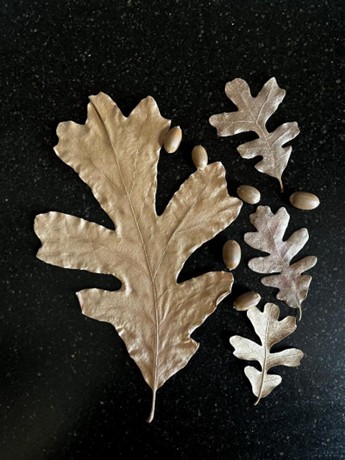
For some reason, the tree has a large range in leaf size. The large leaf in the photo is from a tree in my yard, while the small leaf, which is more typical of the wild trees, came from a neighbor’s tree. The large leaf is 7 inches long and the small ones are about 2.5 inches.
In Colorado, it typically grows in canyons and dry slopes from about 4,000 to 9,000 feet in elevation; above the pinyon/juniper forests and below the aspen/ponderosa forests. For some reason on the Front Range, Denver is about the northern limit of its natural range, whereas in western Colorado, it can be found all the way to the Wyoming border.
It produces small acorns, which serve as food for bears, turkeys, squirrels and other wildlife. Indigenous people are known to have collected and eaten the acorns for millennia. They would shell them and grind them to be used as flour. Deer and elk browse the leaves. Domestic cattle can ingest small amounts of the leaves, but eating large quantities can actually kill them.
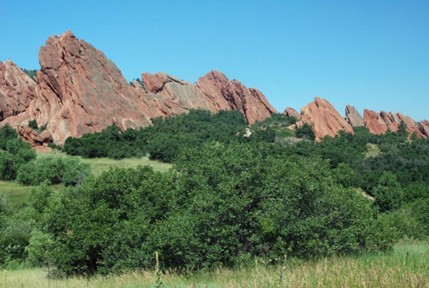
Along the Front Range, large thickets of Gambel Oak can be viewed along the trails and roads at Roxborough State Park, Waterton Canyon and Garden of the Gods. In the wild the tree primarily spreads through underground suckers rather than growing from seeds. Research has shown that the trees in a grove are all monoclonal (they have the same DNA), similar to large aspen forests.
The tree can be propagated from the acorns collected in the wild. Be sure to collect ones without holes from insects. The acorns do not require cold stratification and, reportedly, will start to grow in the Fall as soon as they are planted. The seeds should be planted about 1 inch deep.
I collect acorns every year and have tried numerous ways to germinate them but have had very poor results. WOFR Board Member Kristine Johnson says she has about a 90 percent germination rate with her method. She recommends planting them indoors, immediately after collecting, if possible. If you have to wait, store them in a plastic bag in a refrigerator. The key is to not let them dry out or freeze.

Why does Wild Ones really like Gambel Oaks? It’s because they are insect magnets extraordinaire!! The National Wildlife Federation native plant finder website credits the tree as host to a whopping 221 species of caterpillar-producing insects! Few plants in Colorado come close to this number and most of those are also trees or shrubs. This oak is also the only host to the Colorado state insect, the lovely Colorado Hairstreak butterfly. The Hairstreak feeds solely on the oak and also lays eggs on it.
Consider adding some Gambel Oaks to your yard. You can grow your own, get them at WOFR Chapter plant swaps, or buy them at several commercial nurseries if you have access to them. They are hardy and easy to grow, and can be planted in a corner of your lot or anywhere along a fence row. It’s a great way to support insect and bird life.