
Review by Lani Rush
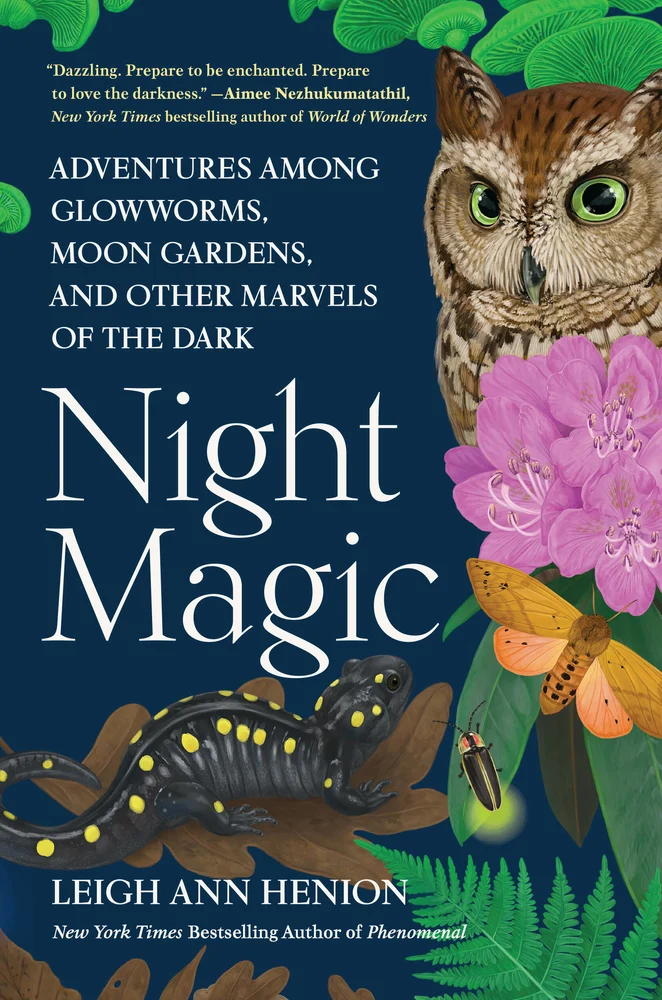
How many stars can you see in your garden? Have you ever sat outside at dusk to watch night blooming flowers? These are just some of the questions on my mind for our members after finishing Night Magic: Adventures Among Glowworms, Moon Gardens, and Other Marvels of the Dark by Leigh Ann Henion. This book hits the high notes of classic nature writing: exploration of the wonders around us, consideration of humanity’s impact – positive and negative – on our environment, and reverence for the abundant and harmonious nature of Earth’s life-giving capacity. If you are a dedicated nonfiction reader, you might find the personal storytelling gratuitous, but if you enjoy consuming stories of connection with the environment, the book is worth the read.
The book’s storytelling is centered on Henion’s investigation of nocturnal ecosystems in her Appalachian area. The book is divided into three narrative sections for Spring, Summer, and Fall, and each season has chapters focused on specific night time plants or animals. We journey to firefly watching, Moth-a-palooza, glowworm hot spots, and forests and public lands still lucky enough to be cloaked in darkness. While the author’s specific encounters are regional, she weaves broader history and ecology into her stories. I enjoyed that each chapter felt like reading a beautiful article with a compact story line of beginning, middle and end. Her style is not perhaps for those readers who prefer a more fact and science based approach, but I find that nonfiction with the author’s positionality in the pages instead of behind the text engages me more deeply.
Night Magic gave me much to think about, especially the realization that “We have inherited, across cultures, sacred-sky stories. But we generally can no longer see the starlight that our ancestors were interpreting.” Grappling with the idea that we could be among the last generations to see the night sky and experience natural darkness that life on Earth has evolved with, is a different environmental lens. The author draws a parallel between artificial light and secondhand smoke – “in the shared airspace of this planet, [artificial light is] pretty much impossible to escape. Everywhere is, in terms of light pollution, like sitting in the smoking section. People light up and the effects spread.” This framing of artificial light as a type of dangerous pollution felt like a wakeup call.
Readers who are short on time might skip to the first chapter of the Fall section, Moon Gardens Glowing. The questions I opened the review with – the personal time we have spent among our plants in darkness – were inspired by this chapter. The author defines moon gardens as “Moon gardens – with plants curated to be enjoyed after sunset – are designed with night bloomers and silver-and-white foliage meant to catch moonlight and ooze perfume.” The moon garden chapter is a journey the author shared with a hobbyist flower gardener, Amy, as they decide to watch night blooming flowers together. The gardener undergoes her own awakening to night, best summarized as: “Amy is always thinking about sunlight, where she should plant things so they might maximize growth. But she’s never considered that pulling her living room shades down or turning off her lights would make any difference for her plants. But now it strikes her as headshaking-hard-to-believe that, though she’s given an occasional thought to shade, she’s never thought much about how natural night is cyclically required for flowers’ photosensitive cycles.”
This chapter made me consider our Colorado biosphere of night. As native plant gardeners, we can consider the prairie and montane darkness our gardens co-evolved with. How might we use our scientific, experimental approach to take action to improve the health of our plants through a good dose of darkness? The book has a few suggestions and further resources (such as Dark Sky International) for those willing to take on the assignment to immediately impact their environment. The book ends with this hopeful, if challenging note – “Reducing light pollution – on both micro and macro levels – doesn’t fundamentally require human technology, only human temperance.”