
Review by Karen Vanderwall
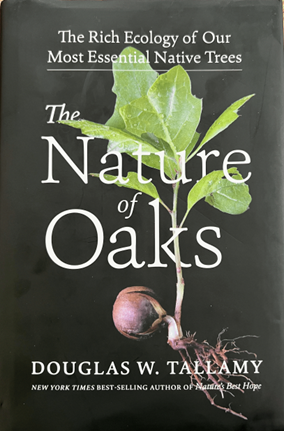
Written by Doug Tallamy in 2001, The Nature of Oaks–his homage to oaks (genus Quercus)–is a pleasure to read from cover to cover. Although I had known of the book, I assumed the book would not be very relevant to me as I now live and garden in an area where there are few oaks. I was happily very wrong as it is so much more than a book about oaks. The message is that, yes, oaks are the rock stars of the vegetative world in North America, but the bigger message is how native species are intricately interwoven with other species that in turn support other species–all playing their part in the greater ecosystem.
The author is a professor of entomology and wildlife ecology, author, and conservationist. He is a hero to the native plant crowd for his promotion of using native plants in home gardens and landscapes to provide habitat for native species. These smaller oases provide a bridge to larger ecosystems like parks. In the beginning of the book, he laments how people in our society today spend so much time indoors on electronics, that our educational system lacks in teaching natural history, and that even highly educated and successful people (including scientists) don’t know what an oak leaf looks like. It is for those reasons that he wanted to write the book.
Tallamy begins the book in July 2000 when he moves into a new home on 10 acres and plants his first white oak acorn. He does suggest this is the best way to plant an oak–via acorns. The story continues from there as he reflects and describes what he has observed on his property and specifically that original oak. Each chapter is a month in the year of his observations and reflections of the oak. As of the time he writes the book the original oak is 18 years old and 45 feet tall.
Each chapter is chock full of interesting stories. There are many about insects such as the relationship of the acorn weevil and Temnothorax ants; the oak tree hoppers, the hairstreaks, slugs, parasitoid wasps, and lace bugs. He provides fascinating examples of insect mimicry of which he has included some wonderful photos.
There are examples of birds such as the blue jay whose physical features reflect it having evolved with the oak. Other chapters describe the interesting critters in the leaf litter, of which he names 20 plus insect groups that depend on oaks. Still others involve the oaks root systems and their importance in soil formation, cool discussions of unique processes such as marcescence (where some deciduous trees retain their dead, withered leaves through winter instead of shedding them in autumn), scientific theories about events such as masting years (periodic seasons when trees produce a massive, synchronized bumper crop of seeds, nuts or fruits), and oaks in our environment. There are also interesting cited research findings throughout, such as how the reduction of habitat is directly related to big reductions of insect and bird populations.
Although native plants are important in the role they play in the ecosystem, all native plants are not created equal. Some oaks, for example, are host to up to 500 species of caterpillars compared to the Yellowwoods, which host none at all. So, oaks are definitely keystone species and then some.
Part of what makes the book so good is that it was written from a personal and scientific perspective, by an educator and also someone who is fascinated and passionate about nature. I finished the book with even more determination to promote native plants; and motivated to replace non-native with native plants in my own yard and as well as planting as many oaks as possible!