
By Benjamin Vogt
Book review by Deborah Lebow Aal
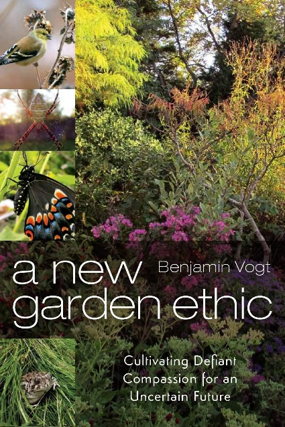
A New Garden Ethic, by Benjamin Vogt, is a call to action to completely shift our ideas of how to garden, and what a garden should be. Vogt is calling for a time of “defiant compassion.” He wants us to stop thinking of gardens for human uses only, and start thinking of the greater ecosystem our plants need to nourish. I think this book is best reviewed by giving you some quotes from the book, because there are so many quotable lines, and I can’t say it better than Vogt has.
“What happens when other species are primary and humans are secondary, if even for a moment? What happens when landscapes stop being mostly for us, but are split more fairly between all species that give meaning to our country, our state, our city and our homes?” (Page 7)
“We need urban gardens that exuberantly embrace wildness in its complex fullness, not in a watered-down echo that does us little good.” (Page 8)
“It’s frustrating when the talk is so often focused on how pretty a plant looks, not on what it’s deeper contribution is to life above and below the soil line.” (Page 12)
“Plants are not for us. We just presume this is the case because we live in a culture that views humans as primary, superior, and all other life – all other intelligence – as secondary, here to be used only for our benefit.” (Page 12)
“How we treat each other and ourselves is reflected in the landscape, in our gardens.” (Page 16)
“Another myth of the garden is that any garden, any composition of plants is better than no garden at all….” (Page 17)
“Of course, our gardens must be pretty… Our culture dictates that a pretty garden is an easily legible one…but because of our disconnection from nature, wild places are less and less legible to us.” (Page 19)
“I wish every gardener could spend a week sitting by a sunflower observing every insect, every interaction, every raindrop and breeze that affects the plant.” (Page 21)
Okay. These are just quotes up to page 21. I could list 100 more. The book describes what we are doing to the planet, in detail, not just with our gardening practices but with our lifestyles. Vogt also focuses on what we need to do with our landscapes. He laments the loss of the tall and short grass prairies that stored so much carbon.
Vogt writes with great passion about the immediate need to understand where our ideas of a “garden” came from, the disconnect we have now from natural systems, and the rather urgent need to change our thinking and actions.
Some may find his passion and advocacy a little too forceful. Vogt wants us to be angry about the state of environmental destruction and then take action to live and dream of a better world. Angry or not, his call to action is sincere and each of us will need to consider how much we can do. This book is required reading for those of us in need of encouragement in stewarding our own yards. And, perhaps, we should consider how we can inspire people who care for public spaces, such as churches and synagogues, to consider this way of thinking and planting as well. I found this small book a powerful nudge out of my comfort zone. You will too.
Deborah Lebow Aal is president of the Front Range Chapter of Wild Ones, is a passionate native plant gardener in Denver, Colorado.